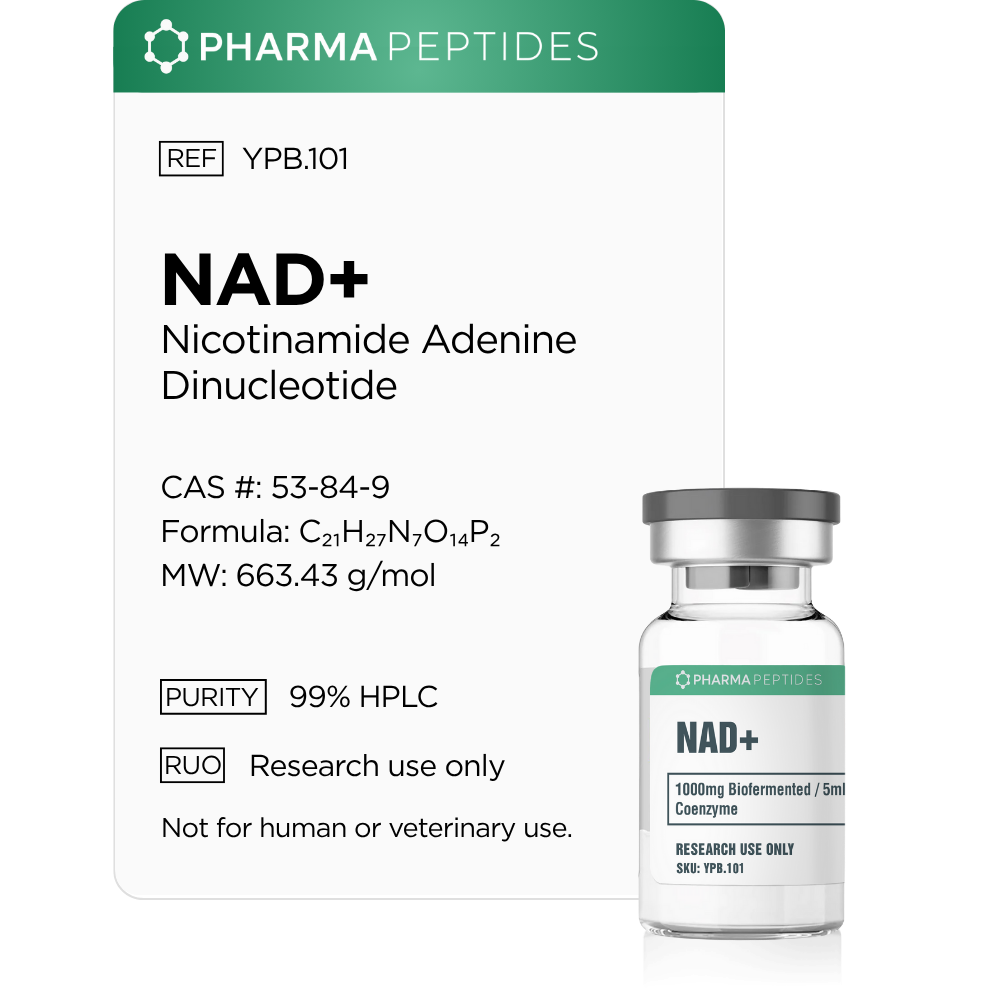
What is NAD+?
NAD+ was first identified in 1906 by Arthur Harden and William John Young while studying fermentation in yeast extracts. They observed that adding boiled yeast extract to unboiled extract altered the rate of fermentation—the heat-stable factor they characterized was later recognized as NAD+.
The molecule’s role in metabolism was elaborated over the following decades. Hans von Euler-Chelpin received the 1929 Nobel Prize for elucidating NAD’s structure and function. NAD+ participates in over 500 enzymatic reactions and serves as a cofactor for enzymes that transfer electrons during cellular respiration and related biochemical processes.
In the early 2000s, published research characterized NAD+ as a required substrate for sirtuin enzymes, a family of deacetylases described in multiple model organisms. Subsequent preclinical research has examined age-associated changes in NAD+ levels and the enzymatic pathways that consume and regenerate it. This buffered formulation maintains pH stability for research applications. This product is intended for research use only.
What is NAD+ studied for?
Tissue Regeneration Research
Investigated in preclinical models for its effects on muscle, tendon, and ligament tissue repair mechanisms.
Wound Healing Research
Examined in animal wound models for observations related to tissue closure and ulcer repair pathways.
Anti-inflammatory Research
Studied in laboratory research for interactions with inflammation-related signaling pathways across various tissue types.
Gastrointestinal Research
Evaluated in preclinical GI tissue models for observations related to gastric and intestinal mucosal integrity.
How should NAD+ be stored?
All of our products are manufactured using the Lyophilization (Freeze Drying) process, which ensures that our products remain 100% stable for shipping for up to 3-4 months. Once the peptides are reconstituted (mixed with bacteriostatic water), they must be stored in the fridge to maintain stability. After reconstitution, the peptides will remain stable for up to 30 days.
Lyophilised (Unopened)
−20°C for up to 24 months
Reconstitution Solvent
Bacteriostatic water recommended
Reconstituted Solution
2–8°C for up to 28 days
Avoid
Repeated freeze-thaw cycles
Handling Notes
Reconstitute slowly by adding solvent to the side of the vial and allowing it to dissolve without agitation. Do not shake. Store away from direct light. All products are shipped with dry ice or cold packs to maintain cold-chain integrity.
Certificate of Analysis
All NAD+ batches are independently tested by a third-party laboratory for purity and identity verification via HPLC with UV detection coupled with Mass Spectrometry.
| Test |
Method |
Specification |
Result |
| Peptide Identity |
Mass Spectrometry |
Confirmed |
Identity Confirmed
|
| HPLC Purity |
Reverse-Phase HPLC |
≥99% |
99.2% — Pass
|
| Endotoxin (LAL) |
LAL Assay |
<1.0 EU/mg |
<0.8 EU/mg — Pass
|
| Heavy Metals |
ICP-MS |
Below USP limits |
All Below Threshold
|
| Appearance |
Visual |
White lyophilised powder |
Pass
|
Independent Lab Verified · Full PDF COA Available on Request